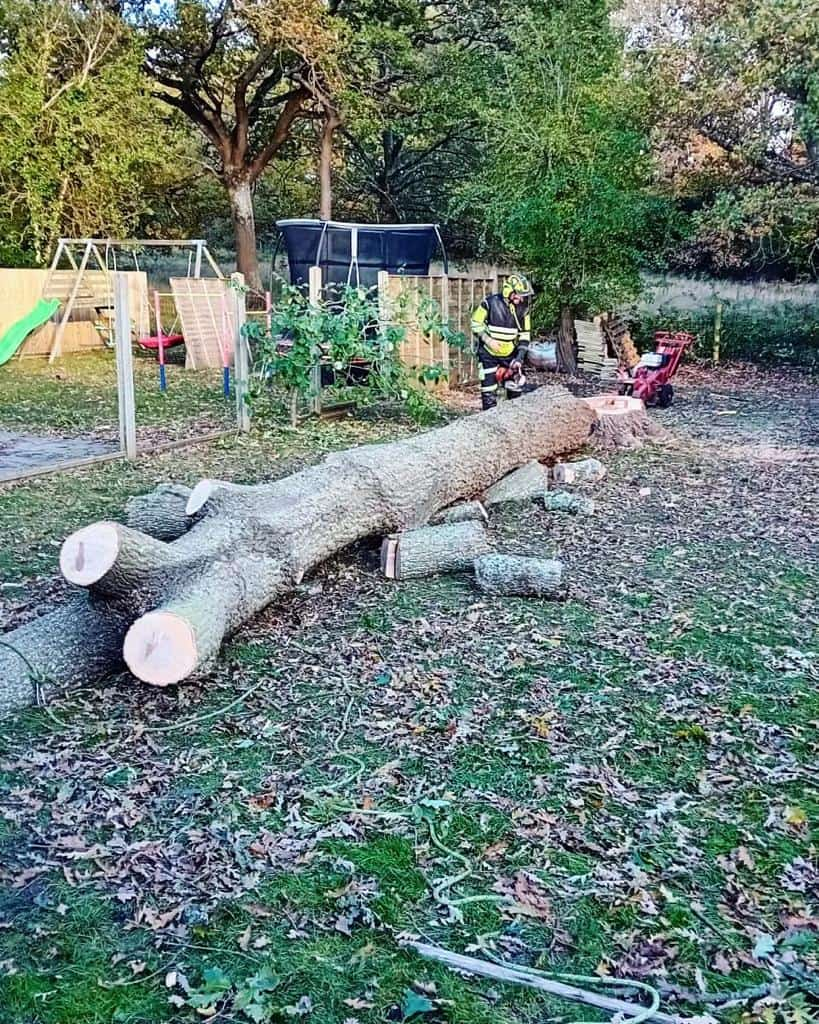
A tree that repeatedly becomes too large for its surroundings can create an ongoing maintenance challenge. Branches may begin extending across lawns, paths or other garden areas, the crown can become increasingly dense, and the tree may start occupying considerably more space than intended. Simply cutting back whichever branches appear inconvenient may provide a temporary improvement, but it does not necessarily provide the most suitable long-term management.
For property owners in Colesbourne, Gloucestershire, the best tree surgery option depends on the tree’s species, condition, natural growth habit and the reason its size has become problematic. Professional assessment can determine whether crown reduction, crown thinning, selective pruning or another form of tree surgery is the most appropriate way to manage continued growth while retaining a balanced tree.
Choosing the Right Tree Surgery for an Overgrown Tree
There is no single pruning method that should be used for every overgrown tree. Two trees of similar size may require very different approaches depending on their structure and surroundings.
Effective tree surgery begins by identifying what actually needs to change. If the entire crown has become too large, crown reduction may be considered. If excessive density is the main concern, crown thinning may be more appropriate. Where only particular branches are causing problems, selective pruning can sometimes achieve the required result without unnecessarily reducing the rest of the tree.
Crown Reduction Can Manage the Overall Size of a Tree
Crown reduction is often considered where the overall height or spread of a tree has become excessive for its location.
Rather than simply shortening random branches, a carefully planned reduction reduces the dimensions of the crown while aiming to retain an appropriate shape and branch structure.
This can be particularly useful where a tree repeatedly extends further into the surrounding garden than desired.
The amount of reduction should be appropriate for the particular tree. Excessive cutting can produce an undesirable response, so the objective should be controlled management rather than removing as much growth as possible.
Crown Reduction Does Not Permanently Stop Growth
Trees are living organisms and will continue developing after pruning.
Crown reduction should therefore be understood as a method of managing growth rather than permanently fixing the tree at one size. Depending on the species and growing conditions, further attention may eventually become appropriate as the crown develops again.
This is one reason why thoughtful pruning is preferable to severe cutting.
A well-planned approach considers how the tree is likely to respond afterwards, helping create a more manageable structure for future maintenance.
Crown Thinning May Help When Density Is the Main Problem
Sometimes a tree feels overgrown because the crown has become particularly dense rather than simply because it is too tall or wide.
Crown thinning involves selectively removing suitable branches from throughout the crown without necessarily making a substantial change to its overall dimensions.
This can create a less congested structure while retaining the tree’s general shape.
It is important to distinguish thinning from reduction. If the real concern is that branches extend too far into the available space, thinning alone may not provide the required result because the outer dimensions of the crown largely remain.
Selective Pruning Can Address Specific Problem Branches
Not every overgrown tree requires work throughout its entire crown.
Sometimes only particular branches are causing difficulty. They may extend over a path, interfere with another part of the garden or create an unbalanced appearance.
Selective pruning can concentrate attention on these areas while leaving suitable growth elsewhere undisturbed.
This can be a particularly sensible approach where the tree generally fits its location but has developed individual branches that no longer work well within the available space.
Repeated Cutting in the Same Places May Not Be the Best Approach
If a tree seems to require attention continually, it is worth considering how previous pruning has influenced its growth.
Simply cutting back new growth to the same points each time does not necessarily create a well-managed crown. Depending on the tree and the type of pruning undertaken, vigorous new shoots may develop and quickly recreate the original problem.
Professional tree surgery considers branch structure and future growth rather than focusing solely on making the tree smaller on the day of the work.
The quality and positioning of pruning cuts can be just as important as the amount removed.
Severe Pruning Can Encourage Strong Regrowth
Removing a large amount of growth does not necessarily mean the tree will remain smaller for longer.
Some trees can respond to heavy pruning by producing vigorous new shoots. This may result in rapid, dense regrowth that requires further management.
Overly severe work can also compromise the natural appearance of the crown.
A measured approach is generally more useful when the objective is ongoing size management. Appropriate pruning can help establish a more balanced framework without unnecessarily stimulating excessive regrowth.
The Tree Species Influences the Best Approach
Different species have different growth habits and responses to pruning.
Some naturally develop broad crowns, while others grow strongly upwards. Growth rates also vary considerably, as does the way individual species respond after branches are removed.
This means a pruning approach that works well for one tree should not automatically be applied to another.
Identifying the species and understanding its natural form can help determine how much work is appropriate and which parts of the crown should be prioritised.
The Reason the Tree Feels Overgrown Matters
Before choosing a tree surgery method, it helps to define the actual problem.
An overgrown tree might be:
- Extending too far across the garden
- Becoming too tall for its surroundings
- Developing an excessively dense crown
- Producing branches that obstruct paths or usable spaces
- Growing unevenly towards one part of the garden
- Becoming crowded by crossing or competing branches
- Requiring increasingly frequent pruning
Each of these situations can call for a different response.
Reducing the complete crown when only one branch is problematic can involve unnecessary work, while removing a handful of branches may achieve very little if the entire crown has outgrown the available space.
Good Tree Surgery Should Retain Balance
Making a tree smaller is only one consideration.
The remaining crown should also retain an appropriate structure and appearance. Removing too much from one side can leave the tree visually unbalanced, while indiscriminate cutting throughout the crown can damage its natural form.
Professional pruning considers the relationship between individual branches and the overall structure.
The objective is to achieve the required management while retaining an appropriate framework for continued growth.
Dead, Damaged and Crossing Branches Can Be Addressed at the Same Time
An overgrown crown may also contain branches that deserve attention for reasons unrelated to size.
Deadwood, damaged growth and unsuitable crossing branches can sometimes be identified during the assessment. Where appropriate, these can be incorporated into the planned tree surgery.
This helps ensure the work considers the condition and structure of the tree rather than concentrating exclusively on its dimensions.
It can also result in a cleaner, more considered crown after the work is completed.
Regular Management Can Be Better Than Waiting for Excessive Growth
Allowing a tree to become substantially overgrown before addressing it can make future management more complicated.
Where a tree is known to grow strongly, periodic assessment can help identify when selective work would be beneficial before extensive pruning becomes necessary.
Smaller, carefully considered interventions can often maintain the desired form more effectively than repeatedly waiting until the crown becomes excessively large.
The appropriate interval will depend on the individual tree rather than following a fixed schedule.
An Overgrown Tree Does Not Automatically Need Removing
A tree becoming too large for its surroundings does not necessarily mean removal is the appropriate solution.
Where the tree remains suitable for its location and its size can be managed through appropriate pruning, retaining it may be entirely practical.
Removal is a very different decision from crown management and should not be assumed simply because regular pruning is required.
Professional assessment can establish whether the conflict is manageable or whether the tree’s natural size and position make ongoing management increasingly unsuitable.
The Available Space Should Influence the Long-Term Plan
Some trees naturally want to become much larger than the space around them allows.
In these situations, pruning may successfully manage the crown, but the relationship between the mature tree and its location should still be considered.
If repeated substantial reductions are required simply to keep the tree within the available space, a longer-term management plan becomes particularly valuable.
Understanding the tree’s likely future growth can help avoid approaching every pruning cycle as an unrelated problem.
Why Professional Assessment Is Important
Choosing between crown reduction, thinning and selective pruning requires more than judging the tree from its size alone.
At EM Tree Surgery Colesbourne, we assess trees in Colesbourne, Gloucestershire by considering their species, condition, crown structure, surroundings and the reason pruning is required.
This helps ensure that the work is matched to the actual problem. Where a targeted approach is sufficient, unnecessary pruning can be avoided. Where broader crown management is required, the work can be planned with the tree’s future growth and overall form in mind.
Conclusion
The best tree surgery option for a tree that keeps becoming overgrown depends on why its growth is causing a problem. Crown reduction can help manage excessive overall size, crown thinning may be appropriate where density is the main concern, and selective pruning can address individual branches without unnecessarily altering the entire crown.
The aim should not simply be to remove as much growth as possible. Appropriate tree surgery considers the species, structure and likely response to pruning so that growth can be managed in a controlled and balanced way.
If you have a tree in Colesbourne, Gloucestershire that repeatedly becomes too large or difficult to manage, contact EM Tree Surgery Colesbourne. We can assess the tree and recommend an appropriate pruning approach based on its condition, growth pattern and surroundings.
Call us on: 01242 569 996
Click here to find out more about EM Tree Surgery Colesbourne
Click here to complete our contact form and see how we can help with your tree needs.